
■ Traditional Rehabilitation Braces
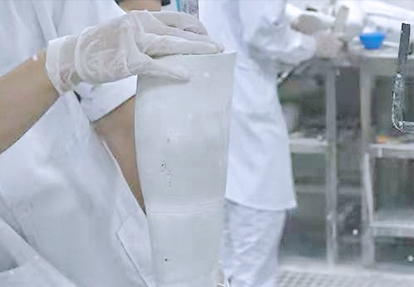
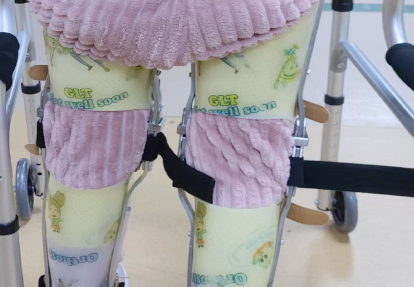
• Standardized orthopedic devices suffer from drawbacks such as imprecise pressure points, inaccurate orthopedic force, and poor fit to the body;
• Misalignment between pressure points and the patient’s skeletal anatomical structure easily leads to imprecise transmission of orthopedic force, significantly reducing correction efficiency;
• Continuous compression of soft tissues by the ill-fitting edges of the brace is prone to causing complications such as skin ulcers and neurotrophic disorders;
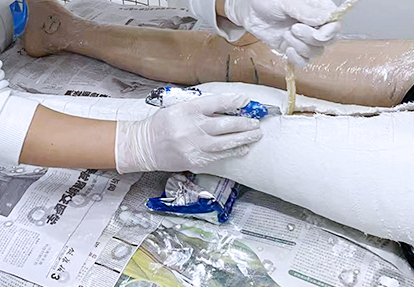
• The production process is cumbersome and still follows traditional methods, which not only brings considerable inconvenience to patients but also poses numerous troubles to manufacturers.
■ New-Type 3D-Printed Rehabilitation Braces
• 4D-printed intelligent orthopedic devices achieve a perfect combination of rigidity and flexibility, featuring high fracture resistance, excellent patient comfort, and enhanced tolerance;
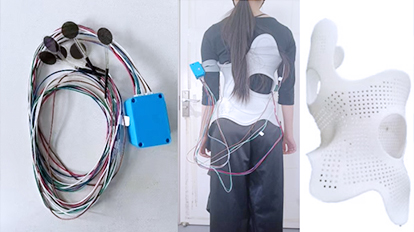
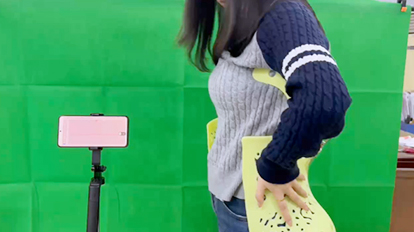
• Integrating front-end scanning, prosthesis design, and 4D printing, a series of intelligent orthopedic devices have been designed and developed;
• Enables personalized design and customization, with shape memory properties allowing free adjustment after structural forming;
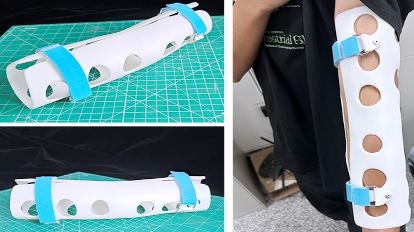
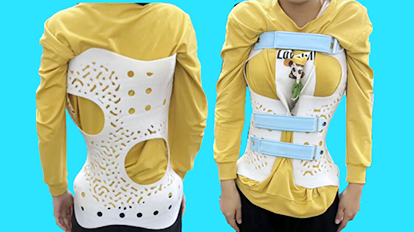
• Suitable for precise fixation during the preoperative and postoperative periods, delivering superior fixation and shaping effects for irregular anatomical sites such as the feet, ankles, and spine;
• Boasts a perfect blend of rigidity and flexibility, resisting breakage, improving patient comfort, and boosting tolerance;
• Repeatable shaping via shape memory performance offers greater advantages in shaping after postoperative swelling reduction in surgical procedures.
• Standardized orthopedic devices suffer from drawbacks such as imprecise pressure points, inaccurate orthopedic force, and poor fit to the body;
• Misalignment between pressure points and the patient’s skeletal anatomical structure easily leads to imprecise transmission of orthopedic force, significantly reducing correction efficiency;
• Continuous compression of soft tissues by the ill-fitting edges of the brace is prone to causing complications such as skin ulcers and neurotrophic disorders;
• The production process is cumbersome and still follows traditional methods, which not only brings considerable inconvenience to patients but also poses numerous troubles to manufacturers.
■ New-Type 3D-Printed Rehabilitation Braces
• 4D-printed intelligent orthopedic devices achieve a perfect combination of rigidity and flexibility, featuring high fracture resistance, excellent patient comfort, and enhanced tolerance;
• Integrating front-end scanning, prosthesis design, and 4D printing, a series of intelligent orthopedic devices have been designed and developed;
• Enables personalized design and customization, with shape memory properties allowing free adjustment after structural forming;
• Suitable for precise fixation during the preoperative and postoperative periods, delivering superior fixation and shaping effects for irregular anatomical sites such as the feet, ankles, and spine;
• Boasts a perfect blend of rigidity and flexibility, resisting breakage, improving patient comfort, and boosting tolerance;
• Repeatable shaping via shape memory performance offers greater advantages in shaping after postoperative swelling reduction in surgical procedures.